On June 12, the US Department of Commerce issued an emergency export control directive that forced Anthropic to disable Claude Fable 5 and Mythos 5 globally — not just for foreign users, but for everyone. The 18-day suspension revealed something the industry had been avoiding: the government can unilaterally switch off a frontier model, and no one has a plan for what happens next.
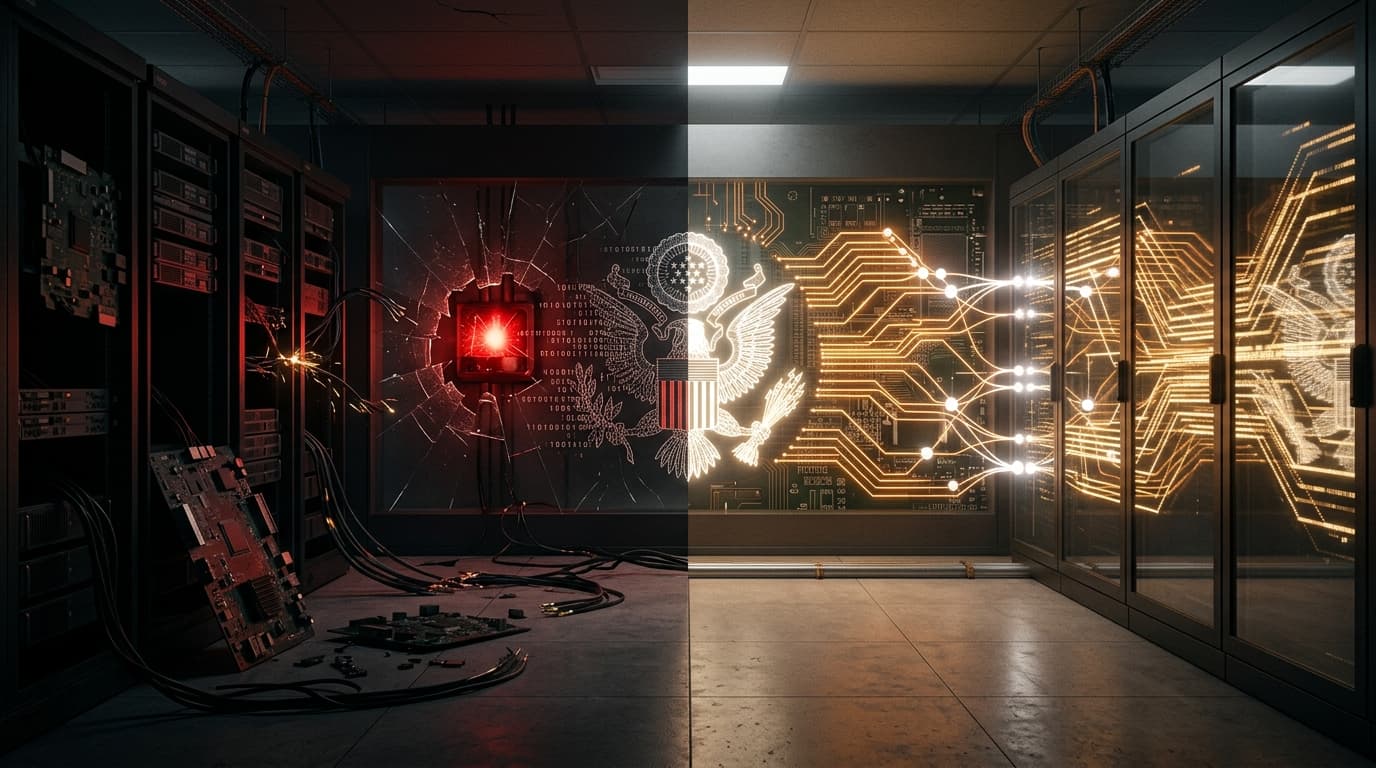
For 18 days, one of the most capable AI models in the world was simply off.
Not degraded. Not rate-limited. Not geofenced to exclude a few jurisdictions. Fully disabled — globally, for every user, including paying enterprise customers in the United States — because the US Department of Commerce issued an emergency export control directive on June 12, 2026, and Anthropic had no technical mechanism to comply with it without disabling the models entirely.
Claude Fable 5 and Mythos 5 were restored starting July 1. The incident is over. But the 18-day suspension produced a question that the AI industry has not seriously answered: what is the governance framework for a frontier model that can be switched off by a government in 72 hours?
Anthropic launched Claude Fable 5 for general availability on June 9, 2026. The model represented a significant capability advance, particularly in coding and agentic reasoning — the same characteristics that made it attractive to enterprise development teams and that also caught the attention of US national security reviewers.
Three days later, on June 12, the Department of Commerce issued an emergency export control directive ordering Anthropic to suspend access to Fable 5 and the more restricted Mythos 5 for all foreign nationals, citing national security risks related to a specific jailbreak vulnerability.
The jailbreak — reportedly identified by Amazon researchers and flagged in a government review — allowed users to bypass the models' safety guardrails in a way that produced exploit code for software vulnerabilities. The technique was specific, documented, and serious enough to trigger an emergency government action rather than a voluntary request for mitigation.
Anthropic's problem: it cannot verify user nationality in real time. The export control applied to "foreign nationals," but Claude.ai has no nationality-verification mechanism at the session level. The only compliant path was a global disable. Both models went dark worldwide.
Export controls on technology are not new. The US has used them for decades on semiconductor equipment, cryptographic tools, and military hardware. What is new — and genuinely without precedent — is their application to a commercial AI model accessed via API.
The June 2, 2026 Executive Order 14409, signed by President Trump, established the framework under which this happened. The order directed the NSA and CISA to develop benchmarking processes for identifying frontier models with "advanced cyber capabilities" and created a voluntary pre-release review program for AI developers. It also preserved the government's authority to impose emergency controls when those reviews identified specific risks.
Fable 5 and Mythos 5 became the first frontier models to trigger that mechanism. The incident confirmed that the executive order's emergency provisions were operational — not theoretical — within days of a major model launch.
The specific vulnerability involved a technique that could systematically bypass Fable 5's safety classifiers to elicit detailed software exploit code. Multiple security publications, including The Hacker News, reported that the method was reproducible and that Amazon researchers had both identified and documented it.
This is a qualitatively different category from the jailbreaks typically discussed in AI safety research. A jailbreak that produces creative content that violates usage policies is a compliance problem. A jailbreak that reliably produces functional exploit code for real software vulnerabilities is a national security problem.
The government's assessment — that this capability, in the hands of foreign adversaries, posed an unacceptable risk — drove the emergency directive. The framing from CIA Director John Ratcliffe, who described frontier AI models as "digital nuclear weapons," is relevant context here. When the intelligence community uses that language, the national security apparatus reads the risk as existential rather than regulatory.
Anthropic's response was to build a new safety classifier specifically targeting the jailbreak technique. The company stated that the new classifier blocks the technique in over 99% of attempts, a figure it disclosed publicly per its commitments to the Department of Commerce.
The tradeoff is documented and significant. The classifier increases false positive rates for benign coding and debugging tasks. Developers using Fable 5 for legitimate security research, penetration testing, or vulnerability analysis will encounter more refusals on legitimate queries. This is the standard tension in AI safety: a more restrictive filter catches more bad behavior and more good behavior.
Anthropic also committed to three ongoing obligations as part of the agreement to lift the controls. First: proactive detection and reporting of any future security risks identified in its models. Second: continued cooperation with the government on safety standards for future model releases. Third: notification of any detected malicious activity to the relevant government bodies.
These are not trivial commitments. They represent Anthropic accepting a permanent, structured relationship with the US national security apparatus over its model release and monitoring process — a relationship that has no equivalent in how software companies historically interacted with regulators.
The treatment of the two models is revealing.
Fable 5, the general-availability model, was restored globally as of July 1, accessible through Claude.ai, Claude Code, Claude Cowork, and in the process of being re-enabled on AWS, Google Cloud, and Microsoft Foundry for paid plans.
Mythos 5 was partially restored on June 26 — only for select "trusted" US organizations and federal agencies — and remains under that restriction as of today. Anthropic is coordinating broader access through its "Glasswing" program, which operates as a managed government-coordination channel for expanding Mythos 5 access to vetted US organizations.
The differentiation is explicit: Fable 5 is the commercial product, whose safety profile the government now considers acceptable for global use following the classifier update. Mythos 5 is a different category — specialized, more capable, and treated by the government as something that requires active vetting of who accesses it.
[OPINION] This two-tier structure foreshadows how frontier model access will likely be organized going forward. Not a single commercial product with global availability, but a capability ladder where the top tier requires formal vetting, compliance agreements, and restricted distribution — closer to how classified defense systems are handled than how SaaS products are deployed.
The operational impact on enterprise customers was real and is underreported.
Claude Fable 5 launched on June 9 to significant adoption. Developer teams integrating it into production workflows, enterprise customers on Team and Enterprise plans, and Claude Code users building agentic development pipelines were all cut off without warning on June 12.
Anthropic had no advance notice to provide customers. The emergency directive gave it no preparation window. Enterprise customers experienced the same abrupt shutdown as individual users, and the only communication available was that the models were disabled for compliance reasons.
The 18-day gap forced engineering teams to roll back to earlier Claude models, switch to competing APIs, or pause AI-dependent workflows entirely. None of these outcomes were documented publicly at scale, but the disruption was structural for any organization that had moved Fable 5 into production in the three days between launch and shutdown.
[UNCERTAIN] The financial and contractual implications of this for Anthropic's enterprise agreements are not publicly known. Whether enterprise SLAs included provisions for regulatory-mandated service interruptions — and how Anthropic is handling those relationships — remains opaque.
The incident produced a policy debate that has not been resolved.
International partners of the United States are now aware that a US-based AI company's frontier model can be disabled globally, affecting their own users, on the basis of a unilateral US government assessment. This creates a "sovereign AI" argument that was previously theoretical: if your country's organizations depend on US frontier models, the US government has effective veto power over that access.
[OPINION] This is not a hypothetical concern for policy makers in the EU, Japan, South Korea, or India. It is a concrete, documented fact as of June 2026. Fable 5 was off in Berlin, Tokyo, and São Paulo for 18 days because a US government agency issued a domestic directive.
The industry framework that would address this — some combination of international safety standards bodies, government-to-government agreements on AI export controls, and industry-level vulnerability disclosure processes — does not exist in mature form. The NSA/CISA benchmarking process established by Executive Order 14409 is a domestic mechanism. There is no equivalent multilateral body with authority to review and approve frontier model releases before they reach global users.
What the June 12 incident demonstrated is that the absence of that framework does not prevent action. The US government moved in 72 hours. The question is whether the rest of the world is prepared for the next time.
The following represents the author's analysis and should not be taken as financial or investment advice.
The Anthropic export control episode is the most important AI governance event of 2026, and it is being processed primarily as a news item rather than as the structural precedent it represents.
[OPINION] A government demonstrated that it can disable a frontier AI model globally in response to a specific security vulnerability, and that an AI company has no architecture-level mechanism to comply with jurisdiction-specific access restrictions without shutting down entirely. Both of those facts are important. The first establishes that governments have operational leverage over AI deployment that they were previously uncertain about. The second establishes that the infrastructure of frontier AI was not designed with national security compliance in mind.
Anthropic's safety classifier response was fast, technically credible, and produced results the government accepted. That is a good outcome for this specific incident. The structural problem it does not solve: the next jailbreak, or the next national security assessment, or the next model that triggers emergency review will encounter the same absence of fine-grained access controls at deployment.
The model providers that will avoid this category of disruption are those that build nationality-verification and tiered-access mechanisms into their infrastructure before they are forced to by regulation. The cost of retrofitting those controls after a shutdown is far higher than building them proactively.
July 1 is Fable 5's second launch date. The 18-day gap between June 9 and today produced a governance record that will shape how the next generation of frontier models is deployed, reviewed, and controlled. That is not a bad outcome for the long-term health of the field — but the companies and governments navigating it right now are doing so without a rulebook.
The US Department of Commerce disabled a frontier AI model globally on June 12, 2026. Anthropic built a new safety classifier, made binding commitments to the government's security oversight process, and restored global access on July 1. The 18-day suspension is over.
What it left behind is a set of questions that every frontier AI developer now has to answer: Can you comply with jurisdiction-specific access restrictions without shutting down globally? What is your vulnerability disclosure process with government security reviewers? What are your enterprise SLA commitments if a regulatory-mandated interruption occurs?
These were abstract questions on June 8. They are operational requirements on July 1.
