Global data center electricity consumption is forecast to reach 565 TWh in 2026 — a 26% jump in a single year — and grid infrastructure cannot keep up. Hyperscalers are now acting as energy companies, building dedicated nuclear and gas capacity, because access to reliable power has become the binding constraint on AI infrastructure.
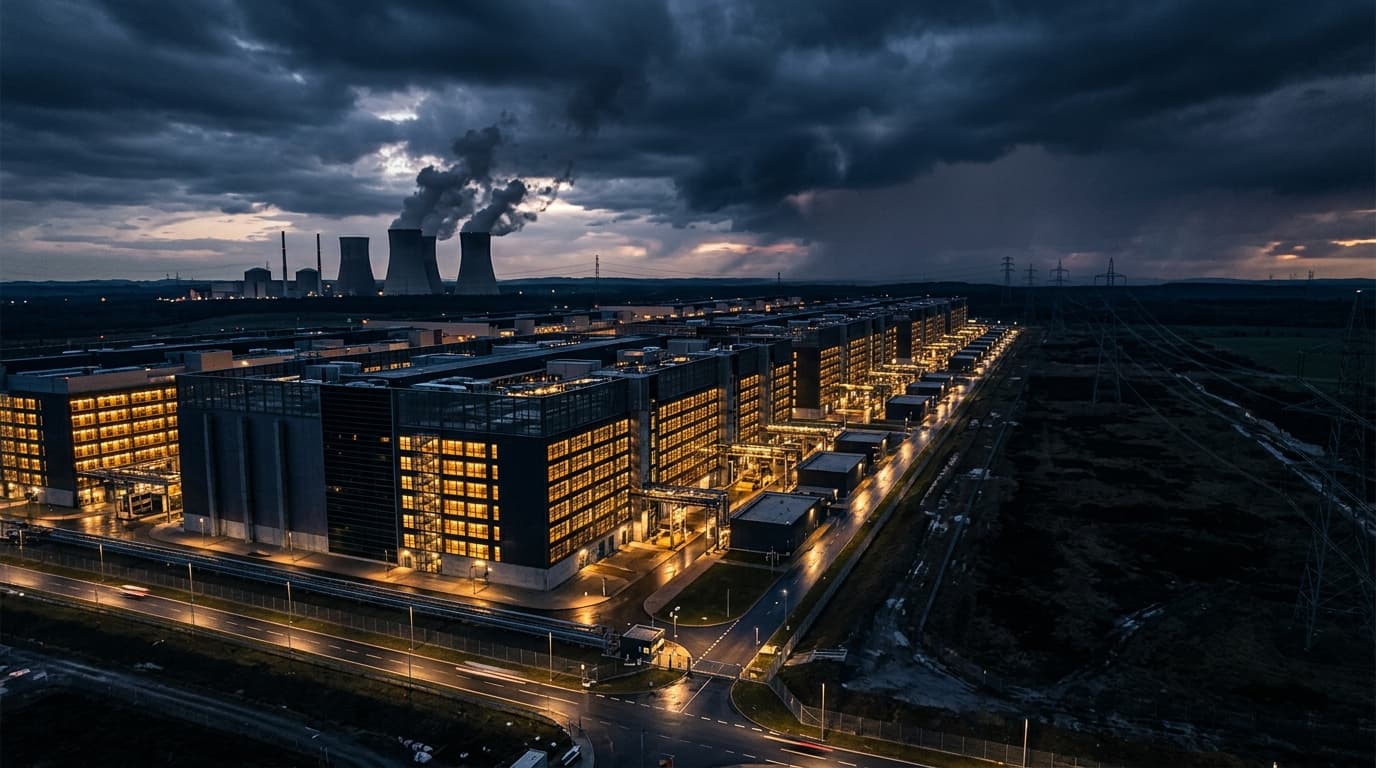
The servers are ready. The land is acquired. The racks are ordered. The construction crews are on site.
And the project is stuck — waiting for electricity that won't arrive for seven years.
This is the defining infrastructure constraint of 2026's AI build-out, and it is not a software problem. It is a physics and regulatory problem: electrical grid expansion in most countries takes a decade. Data center construction takes two or three years. The gap between those timelines is where multi-billion-dollar AI compute investments go to stall.
Global data center electricity consumption is forecast to reach 565 TWh in 2026, a 26% increase over 2025 levels, according to multiple energy research forecasts. By 2030, projections place that figure at 945 TWh. The trajectory is not slowing — it is accelerating with AI workload density, which is significantly more power-intensive per rack than traditional cloud compute.
The consequence is a market transformation that few technology analysts predicted: hyperscalers are becoming energy companies.
The electrical grid was not designed for this. Transmission infrastructure built over decades to serve industrial facilities and residential loads is being asked to route extraordinary power volumes to data center campuses that did not exist five years ago.
The bottleneck is in the interconnection queue. Globally, over 2,500 gigawatts of projects are currently waiting in grid connection queues, according to industry reporting aggregated across multiple infrastructure sources. Most of these projects will wait years before receiving a firm interconnection date. In the United States, the median interconnection queue time has stretched to over 5 years in several regional transmission operator zones. In Europe, the figure varies by country but routinely exceeds three to seven years for large loads.
For an AI data center project, this creates an economic problem with no software fix. You can optimize your cooling systems, compress your transformer footprint, and negotiate aggressively with contractors. You cannot compress a seven-year grid interconnection timeline into two.
The industry term for this problem has shifted. In 2024, the question was "which cloud provider offers the best GPU availability?" In 2026, the question is "who has time-to-firm-power?" The latter has become the most critical economic variable for AI infrastructure viability.
Amazon, Google, Microsoft, and Meta have each reached the same conclusion independently: the public grid is not a reliable path to the power they need on the timeline they need it. The response has been to vertically integrate into energy generation.
This is not a marginal adjustment. These companies are deploying capital at a scale that redefines what "tech company" means.
Microsoft's Three Mile Island deal is the clearest example. Microsoft negotiated a contract to bring the Three Mile Island nuclear facility — shuttered since 2019 — back to full operation to supply dedicated power to its AI data center campuses. The deal, which involved significant capital commitment from Microsoft, is not a renewable energy credit purchase. It is a direct power offtake agreement tied to a specific generation asset.
Google, Amazon, and others are pursuing Small Modular Reactors. SMRs — next-generation nuclear reactors designed for faster construction and smaller physical footprints than traditional nuclear plants — have become a priority investment target for hyperscalers. The appeal is specific: nuclear power provides 24/7 carbon-free baseload generation that neither wind nor solar can match at scale. For an AI training cluster that cannot tolerate downtime, intermittent renewable generation with battery storage is structurally insufficient.
Natural gas is filling the gap in the interim. Many operators are incorporating on-site natural gas turbines and fuel cells as bridge capacity while longer-term nuclear and renewable projects develop. This is not environmentally neutral, and hyperscalers with net-zero commitments are navigating the tension publicly. The practical reality is that AI workloads have a power requirement that does not adjust to match available generation.
When power availability becomes the binding constraint, the geography of data center investment follows power, not historical tech corridors.
Locations with abundant hydroelectric power — Norway, Iceland, the Pacific Northwest of the United States, and parts of Canada — are seeing increased site evaluation activity. North Dakota, traditionally not a technology hub, has been cited in multiple infrastructure reports as an emerging data center destination due to available land, cold climate (reducing cooling costs), and improving power access.
This creates a structural divergence from the last two decades of cloud geography, when proximity to major metropolitan areas and submarine cable landing stations was the dominant siting factor. A data center in rural Norway serving inference workloads for European users represents a different infrastructure topology than a suburban Virginia hyperscale campus.
[UNCERTAIN] It is not yet clear whether latency requirements for real-time AI inference will eventually constrain this geographic dispersion, or whether model-serving architectures will adapt to accommodate more distributed, power-optimized siting. One interpretation is that training workloads — which are latency-insensitive and power-intensive — migrate to power-abundant remote sites, while inference capacity remains closer to users.
The capital cost of securing dedicated power generation is not trivial, and it is not uniformly distributed across cloud providers.
Amazon, Google, and Microsoft have the balance sheets to execute multi-decade nuclear offtake agreements and SMR equity investments. The capital requirements for these strategies — in some cases running to hundreds of millions of dollars per deal — are effectively a moat. Smaller cloud providers and regional competitors cannot replicate this approach at scale.
[OPINION] This suggests that the AI compute market is consolidating around the providers who can solve the power problem, not merely the providers who can build the fastest hardware. GPU availability was the constraint in 2024. Power availability is the constraint in 2026. The next year will reveal whether the companies that moved earliest on energy — Microsoft, in particular, with its Three Mile Island deal — gain a durable lead in AI infrastructure capacity.
The FinOps Foundation's recent expansion of its mission to cover "Value of Technology" — including AI infrastructure costs — reflects how seriously enterprises are treating this. Cloud billing for AI workloads is already substantial. If power costs rise as expected when dedicated generation assets begin pricing at market rates, the total cost of AI compute will increase further, and FinOps teams will be managing energy exposure as a core part of cloud governance.
The tech industry's relationship with renewable energy is undergoing a visible stress test.
For most of the 2010s, hyperscalers solved their sustainability commitments through renewable energy certificates and power purchase agreements for wind and solar capacity added to regional grids. These mechanisms worked reasonably well when compute loads were growing incrementally and when the grid could absorb renewable intermittency.
AI workloads break both assumptions. Training clusters and inference infrastructure require constant, dispatchable power that adjusts to workload demand — not generation patterns determined by wind speed and daylight. Battery storage can buffer intermittency at some scale, but the capital cost and land footprint required for battery-backed solar or wind to reliably serve a 100+ MW data center campus is substantially larger than the equivalent nuclear or gas solution.
Several hyperscalers have responded by transitioning from renewable energy credit purchases to direct ownership of generation assets — a fundamentally different level of engagement with the energy sector. This approach provides firmer power guarantees but introduces new operational complexity: these companies now have exposure to nuclear fuel costs, plant maintenance risk, and regulatory environments they have never navigated before.
The honest assessment from industry analysts is that renewables remain a meaningful part of the procurement mix — particularly for grid-connected capacity where intermittency can be managed regionally — but they are no longer sufficient as the primary strategy for hyperscale AI infrastructure.
The following represents the author's analysis and should not be taken as financial or investment advice.
The power crisis in AI infrastructure is a textbook case of infrastructure debt coming due at the worst possible moment. Grid expansion in most Western countries has been chronically underfunded relative to both load growth projections and the political commitments made around electrification and industrial reshoring. AI has accelerated demand on a timeline that grid investment cannot match.
[OPINION] The consequence is not evenly distributed. The hyperscalers who moved early — particularly Microsoft, with its nuclear offtake strategy — are not just solving a near-term constraint. They are acquiring a structural advantage that smaller competitors will spend years trying to replicate. Power access is now a competitive moat in AI infrastructure, in the same way that GPU supply was a moat in 2023–2024.
The nuclear revival is real but should be understood precisely. SMRs are compelling in theory, but first commercial deployments are still years away in most jurisdictions. Three Mile Island's reactivation is the more immediately relevant model — restarting existing proven capacity on a faster timeline than new construction. Expect more deals structured this way before SMRs are commercially viable at scale.
The geography shift is permanent. AI compute has already begun decoupling from traditional tech geography, and that decoupling will accelerate as power constraints force site selection toward energy abundance rather than metropolitan proximity. This has implications for workforce, regulatory environment, and infrastructure investment patterns that extend well beyond the technology sector.
Power availability has replaced GPU availability as the primary bottleneck in AI infrastructure. The numbers are not ambiguous: 565 TWh consumed in 2026, growing to 945 TWh by 2030, against a grid expansion pipeline that takes a decade to execute.
The hyperscalers' response — direct nuclear offtake, SMR investment, on-site gas generation — is rational and correctly targeted. It is also expensive, operationally complex, and structurally inaccessible to smaller competitors. The AI compute market is consolidating around energy access, and the companies building dedicated generation capacity today are building the infrastructure that defines the competitive landscape for the next decade.
The power grid is not going to move faster. The question is which organizations have already secured the power they need before that constraint becomes universal.
